Training an object detector from a few examples: FT-FSOD
A new viewpoint, industrial scene or unfamiliar equipment category can change recognition conditions. FT-FSOD studies how to fine-tune a pretrained detector with a small support set and evaluate robustness.
Research authors: Xuanlong Yu, Youyang Sha, Longfei Liu, Xi Shen, Di Yang
Intellindust AI Lab · Suzhou Institute for Advanced Research, USTC
Research review and localized figure labels by Deepvizor. Original figures and results come from the paper; the complete publication is linked as a PDF.
Open full-size research figure ↗
Small datasets need careful adaptation. FT-FSOD combines progressive fine-tuning with a hybrid ensemble decoder that diversifies predictions without adding parameters.
Why recognition changes at a new site
Object detectors are usually trained using annotated images with class labels and bounding boxes. Enterprise conditions may differ substantially: industrial components, ceiling-mounted cameras and poor lighting do not resemble ordinary benchmark photographs.
This change is called domain shift. A detector may recognize a class in one environment and fail in another. Cross-domain few-shot detection combines limited examples with a substantial change of scene, so the adaptation procedure matters as well as annotation volume.
FT-FSOD studies fine-tuning pretrained detectors in this setting. The paper was accepted at CVPR 2026. This review presents the method and results, followed by practical implications for enterprise evaluation.
How the hybrid ensemble decoder works
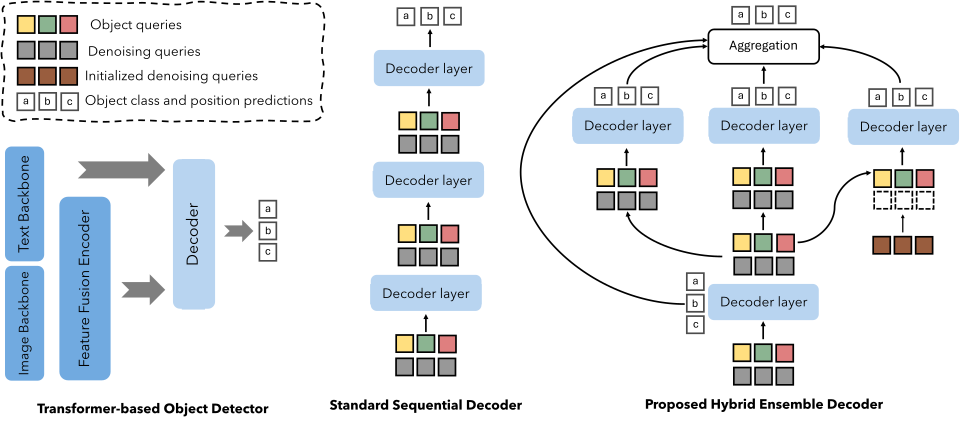
DETR-family detectors use learned object queries to interact with image features. Decoder layers refine object classes and positions. A sequential decoder passes each layer’s output to the next.
HED keeps shared early layers and rearranges some later layers into parallel branches whose predictions are aggregated. Different branches provide more diverse predictions, supporting generalization under domain shift.
Training also uses denoising queries, abbreviated DN. Some are inherited and others are reinitialized to diversify parallel-branch inputs. Pretrained weights are reused without additional parameters; the method does not train several independent large networks.
In the original diagram, colored squares are object queries, gray squares are denoising queries and brown squares are initialized denoising queries. The letters a, b and c represent class-and-position predictions, not actual class names.
Progressive fine-tuning with limited data
The encoder is frozen initially. Training adapts the remaining detector components while preserving its image representation. After the first optimization plateau, the encoder is unfrozen so its features can adapt after the cautious initial stage.
The learning rate follows a plateau-aware schedule. The authors use a unified procedure across datasets instead of extensive task-specific hyperparameter searches. Complex data generation is not a required part of the recipe.
Few-shot is different from training-free inference. FT-FSOD updates model weights using annotated examples, while FSOD-VFM uses foundation models and graph diffusion without additional detector training. Data preparation and computational requirements differ.
What the research experiments show
The authors evaluate CD-FSOD, ODinW-13 and RF100-VL. RF100-VL combines 100 heterogeneous tasks. At 10 shots, the proposed method reaches 41.9 average mAP; SAM3 is reported at 35.7 in the comparison, a difference of 6.2 mAP points.
Ten-shot means ten annotated examples per class under the research protocol, not a guarantee that ten frames suffice for any industrial camera. The original table also notes differences in model-selection procedures; full conditions are in the paper.
mAP averages detection precision under a specific test protocol. It is not the share of correctly delivered alarms and does not replace evaluation of an operational enterprise scenario.
Scroll the table horizontally →
| Method | Mean mAP |
|---|---|
| SAM3 | 35.7 |
| FT-FSOD · MMGDINO-L | 41.9 |
Unfamiliar data and overconfident errors
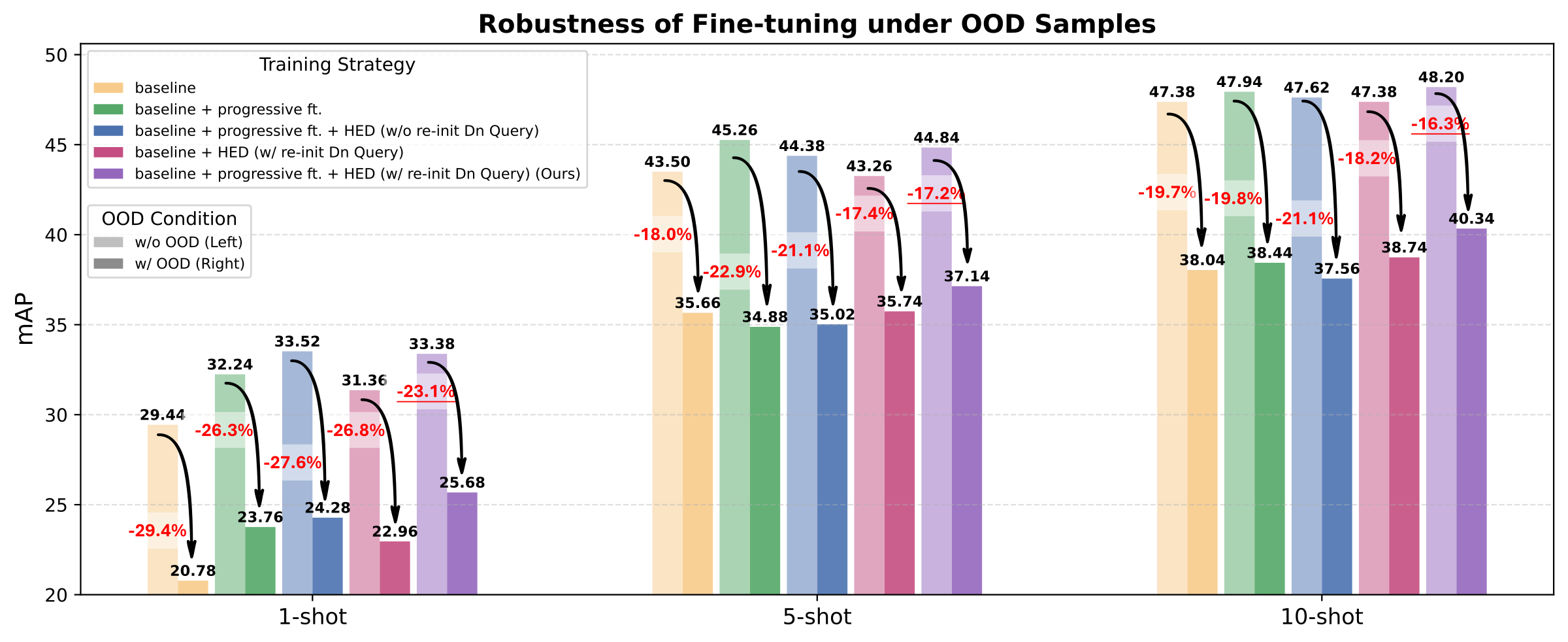
The authors construct CD-Mixed by combining target-domain images with other domains. A detector fine-tuned on one domain encounters unrelated scenes, testing whether it produces confident boxes where the target is absent.
At 10 shots, the original chart reports 47.38 mAP without OOD and 38.04 with OOD for the baseline, versus 48.20 and 40.34 for full FT-FSOD. All five strategies, numeric values and reported reductions are preserved. Progressive fine-tuning alone does not improve every metric equally; components need joint evaluation.
For a pilot, this principle means testing ordinary non-violation scenes, nearby equipment and confusing objects. Negative clips reveal false positives that a selection of successful detections would miss.
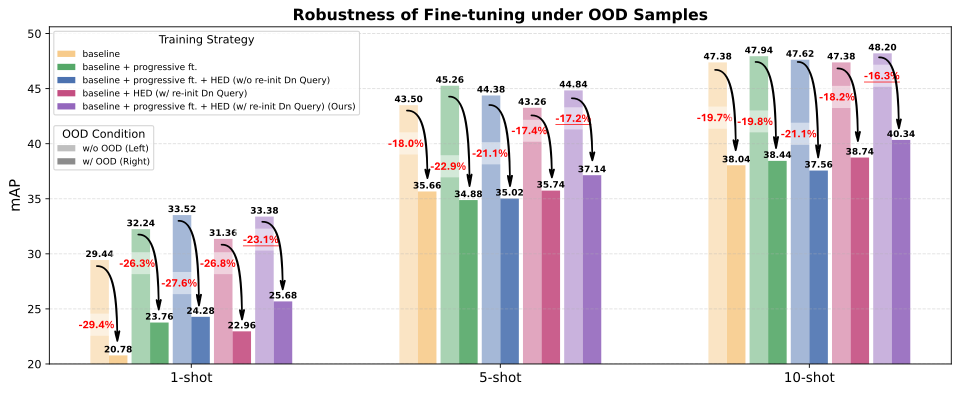
Original FT-FSOD chart. OOD means out-of-distribution inputs; DN means denoising queries. Values and relative changes are preserved.
Preparing data for video analytics adaptation
Define the class and event rule first. “Forklift inside a zone” includes recognizing the vehicle, locating it and checking zone boundaries. Detector adaptation solves only part of that chain.
Collect independent episodes across viewpoints, working distances, occlusions and lighting. Apply consistent bounding-box and class-label rules. Reserve a different day or camera for evaluation so neighboring frames do not leak between preparation and testing.
Evaluate misses and false detections together, then connect the event rule, dashboard and response channel. Research benchmarks inform approach selection; deployment performance must be measured on site cameras.
Questions about detector training
How many examples are needed? The paper studies 1-, 5- and 10-shot settings and additional benchmarks. Enterprise data requirements depend on object and capture diversity; a benchmark number is not a deployment standard.
Must the entire video be annotated? Detector fine-tuning requires annotated images with target objects. Temporal event evaluation also requires complete episodes. It helps to keep training preparation and event validation separate.
Should an existing detector be tried first? Yes: evaluate it on the actual cameras. Adaptation cannot recover detail missing because of a poor viewpoint. If classes and conditions are genuinely new, discuss data preparation and fine-tuning.
BibTeX
@inproceedings{yu2026acloser,
  title={A Closer Look at Cross-Domain Few-Shot Object Detection: Fine-Tuning Matters and Parallel Decoder Helps},
  author={Yu, Xuanlong and Sha, Youyang and Liu, Longfei and Shen, Xi and Yang, Di},
  booktitle={CVPR},
  year={2026}
}
Sources and licensing
FT-FSOD · Xuanlong Yu, Youyang Sha, Longfei Liu, Xi Shen, Di Yang. Research and figures: CC BY 4.0. Review and localized labels: Deepvizor, 15 October 2026. Diagram geometry, photographs and numeric values are preserved; GTR examples receive column labels.
Original paper · CC BY 4.0 · Editable review and translation source
Explore the detector library and Deepvizor hardware.