Real-time object detection: DEIMv2 meets DINOv3
A fast detector needs both detailed image understanding and a manageable compute budget. DEIMv2 combines DINOv3 features with models spanning GPU, edge and mobile deployment.
Research authors: Shihua Huang, Yongjie Hou, Longfei Liu, Xuanlong Yu, Xi Shen
Intellindust AI Lab · Xiamen University
Project-page presentation and explanatory additions by Deepvizor. The full paper is available through the PDF link. Results apply to research datasets.
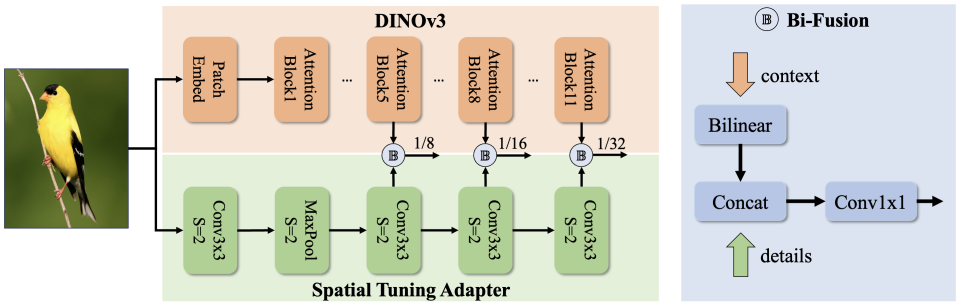
Open full-size research figure ↗
DEIMv2 is a family of eight sizes, not a single universal model. STA combines context with fine detail, while the smallest models use a different backbone.
Abstract: eight models for different devices
Dense O2O gave DEIM faster convergence and improved detection performance. The authors extend this recipe with DINOv3 features to create DEIMv2, spanning eight model sizes from X to Atto for GPU, edge and mobile deployment.
X, L, M and S use DINOv3-pretrained or distilled backbones. The Spatial Tuning Adapter, or STA, transforms DINOv3’s single-scale output into multi-scale features and complements strong semantic representations with fine-grained detection details.
Ultra-lightweight Nano, Pico, Femto and Atto use HGNetv2 with depth and width pruning to meet strict resource limits. A simplified decoder and upgraded Dense O2O combine these choices into a unified family with different performance–cost trade-offs.
Method: context and detail at several scales
The upper branch of the source diagram extracts DINOv3 features. The lower STA branch supplies local detail through convolutional operations and spatial downsampling. Fusion nodes connect the two representations.
The resulting features have scales of 1/8, 1/16 and 1/32 relative to the input image. The Bi-Fusion detail shows bilinear resizing, channel concatenation and a 1 × 1 convolution. This explains the published architecture; it is not a separate Deepvizor experiment.
Semantic features describe what is in the image, while local representations help locate boundaries and smaller elements. STA brings both types of information into downstream detection.
Results: detection quality and model size
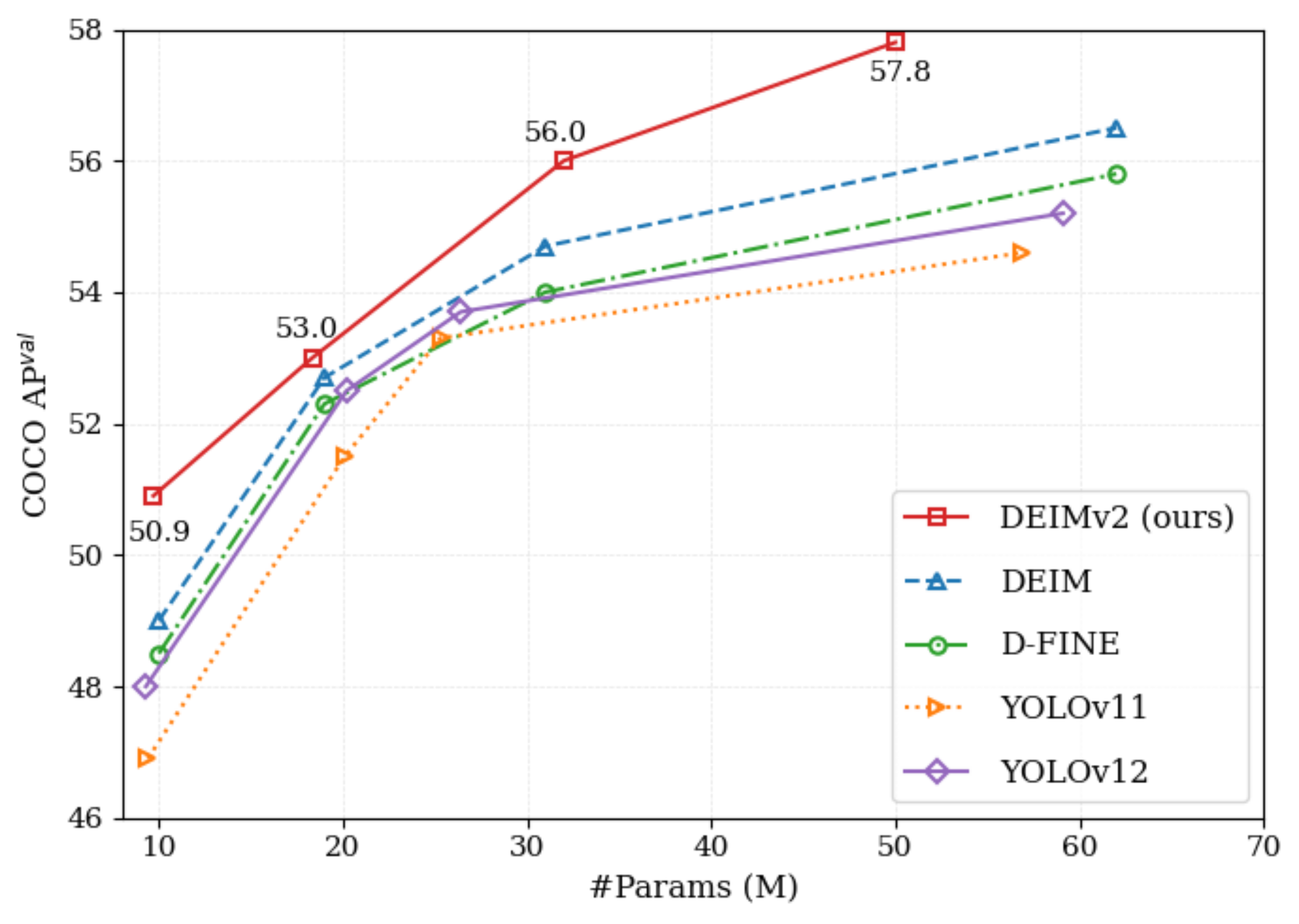
DEIMv2-X reaches 57.8 AP with 50.3 million parameters. DEIMv2-S achieves 50.9 AP with 9.71 million parameters, crossing the reported 50 AP threshold below 10 million parameters.
DEIMv2-Pico uses 1.5 million parameters and reaches 38.5 AP. The source compares this AP with YOLOv10-Nano at 2.3 million parameters. The table preserves the three variants explicitly reported in the abstract.
AP is a detection metric on the COCO benchmark, not the percentage of correctly handled industrial alarms. The chart compares AP with parameter count; it does not report latency on Deepvizor devices.
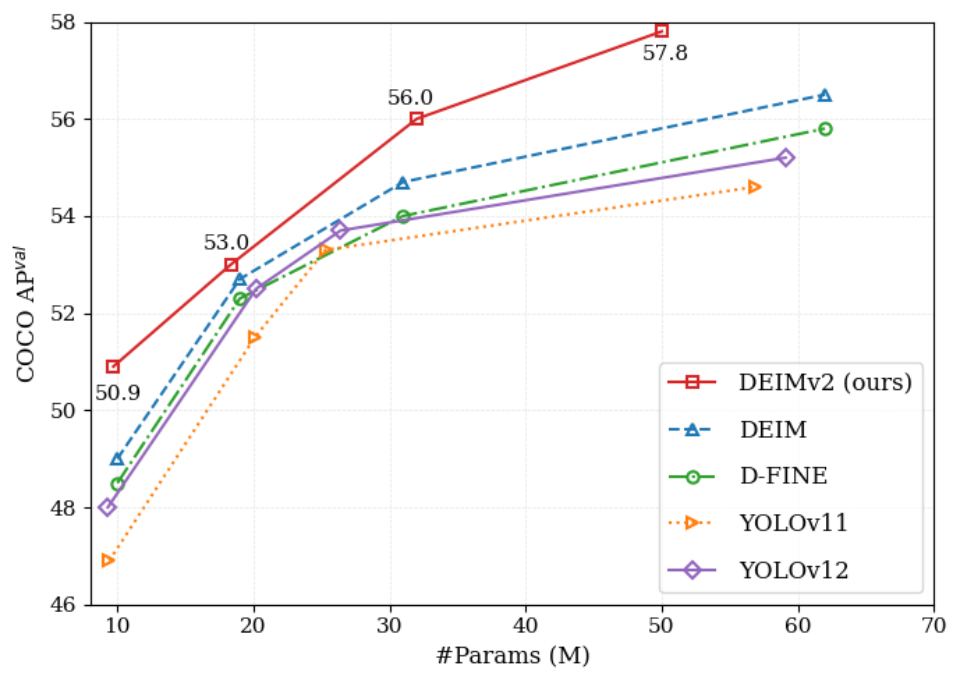
Original AP-versus-parameters chart, with curves and values preserved.
Scroll the table horizontally →
| Model | Parameters, M | AP |
|---|---|---|
| DEIMv2-X | 50.3 | 57.8 |
| DEIMv2-S | 9.71 | 50.9 |
| DEIMv2-Pico | 1.5 | 38.5 |
Deepvizor note: choosing a model size
Start with the target event and camera conditions. A small distant object and a large object near an entrance may require different input resolutions and quality margins. An algorithm name alone does not determine processing load.
Measure the complete pipeline during a pilot: stream ingestion, decoding, inference, event rules and notification. Compare models on identical video and the intended hardware, considering memory, numerical precision and simultaneous camera count alongside parameters.
Original paper and code
Code and pretrained weights are available in the DEIMv2 repository. The source project and full paper are linked above; the authors’ citation follows.
BibTeX
@article{huang2025deimv2,
  title={Real-Time Object Detection Meets DINOv3},
  author={Huang, Shihua and Hou, Yongjie and Liu, Longfei and Yu, Xuanlong and Shen, Xi},
  journal={arXiv},
  year={2025}
}
Translation and source
Real-Time Object Detection Meets DINOv3 · Shihua Huang, Yongjie Hou, Longfei Liu, Xuanlong Yu, Xi Shen. Project-page translation, localized diagrams and explanatory notes: Deepvizor, 17 October 2026. Source photographs and experimental values are preserved. Deepvizor notes are labeled separately.
Original · GPL-3.0 · Editable translation source · Original page source
Explore the detector library and Deepvizor hardware.